Thursday, January 5, 2012
Dmitri Mendeleev's first Periodic Table
Dmirtri first categorized the elements on the periodic table by their atomic weights and properties. Their properties were sorted into groups such as alkali metals, alkali earth metals, transition metals, poor metals, non metals, and noble gases. Atoms are most happy with 8 valence electrons and become stable. Valence electrons are the number of electrons in the outer most atomic orbital shell in an atom. To find how many valance electrons you have in an atom, you have to start in the group of its period and count across until you reach it. The amount of times you count across is the number of valance electrons. This has to do with the octet rule which clarifies that the atom needs to have 8 electrons in the outer shell to be stable. For example if an element only has 7 it can gain one from another element and become stable. That one that it gains from will also become 8 since it lost 1 and goes back to 8. If you follow the octet rule then every atom will be stable and happy!

Thursday, December 1, 2011
Energy Sources
Electricity always had interested me. I never knew how it worked. In chemistry this past week i have learned that it involves protons, neutrons and electrons. They all continually revolve around the nucleus. The nucleus has the most power and it controls everything else. 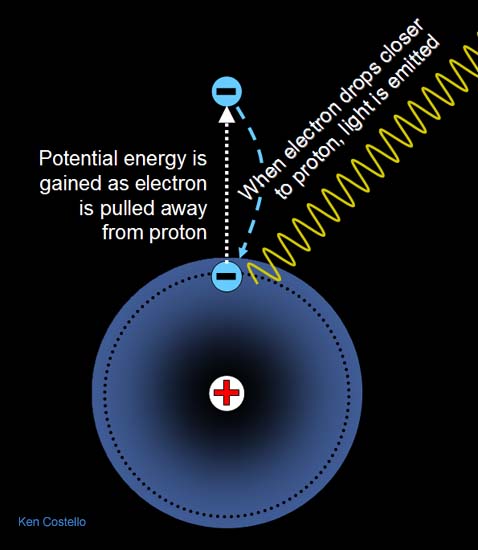
This picture found on Chemistryland.com helped me visually see what happens.
Electricity can power anything from a lamp to a whole town or city. Without electricity in this world we wouldn't have heating, air conditioning, cold or warm food, technology, cars, and most importantly light!
This picture found on Chemistryland.com helped me visually see what happens.
Electricity can power anything from a lamp to a whole town or city. Without electricity in this world we wouldn't have heating, air conditioning, cold or warm food, technology, cars, and most importantly light!
Tuesday, November 22, 2011
Cetyl Alcohol Lab

For a period of about 4 minutes the temperature of the Cetyl Alcohol remained at 50 degrees Celsius. At first we were extremely confused and weren't sure if we had done something wrong. We then realized that the Cetyl Alcohol was changing phases and that was why there was no change in temperature.

The first thing we did was place a beaker with 400mL of water on a hot plate until it heated to 70 degrees Celsius.

After it was fully heated, we placed the test tube filled with cetyl alcohol into the beaker. From then on, we measured the temperature every 30 seconds until it reached 60 degrees Celsius.

Once the cetyl alcohol test tube reached 60 degrees Celsius, we placed it in an ice bath until it reached the starting temperature once again, 30 degrees Celsius.
The Data Conclusion:
In the cetyl alcohol lab, we accidentally started off with some errors. When the beaker of water reached 70 degrees Celsius, we didn't realize we were supposed to take it off the hot plate, and therefore, we kept on heating the water as we put the Cetyl Alcohol test tube in the hot water. We then took the beaker off the hot plate after we realized our mistake and started measuring the temperature with the beaker at around 80 degrees Celsius and the Cetyl Alcohol at about 30 degrees Celsius. After 9 minutes and 30 seconds, when the Cetyl Alcohol solution reached 60 degrees Celsius, we took the test tube of Cetyl Alcohol and put it into the ice water bath. We then let the temperature cool from 60 degrees Celsius until it reached 30 degrees Celsius after about 9 minutes. What we noticed about the test tube of Cetyl Alcohol while it was on the hot plate was it started melting. Because of the series of about 4 minutes of 50 degrees Celsius, we determined that must be a phase change and as it was going from solid to liquid we considered it melting. Then, when we took it off the hot plate and placed it into the iced water beaker, it there was another plateau as it froze at about 37 degrees Celsius.
Data conclusion by Myself and Marie Stockton
Pictures taken by Katie faryniarz
Graph made by Kevin and Katie
Graph made by Kevin and Katie
Thursday, November 17, 2011
Websites- Valid or Invalid information?
Everyday websites i use normally for information is databases on the school network. I think they are the most accurate for information because the school makes sure that i can contact the author if theres a problem, if the information is correct, if it is useful and more. I used to use google and type in whatever the information i needed and the first one i saw i would click on it. Now i know that it is probably the biggest waste of time because half of them are blogs of people sharing their opinions. Opinions are good in some situations but looking for useful facts, blogs are not the website to go to. First of all the author might not even know that much on the topic and never studied it, and second of all it never covers a lot on the subject. Therefore i would choose databases over blogs for valid information.
Sunday, November 13, 2011
College
My parents always told me that doing activities outside of school and being unique would get me into a good college. I do many unique activities that i enjoy a lot. For example, i intern for the magazine Serendipity which i enjoy very much and believe it is good for colleges. I also help out with the JDRF foundation because my cousin has diabetes and its a big foundation for my family. Lastly, i love art and many people say i am artistic so i am going to join artistic clubs like photography and take classes like clay and sculpture. I believe having unique experiences that you enjoy will make any college want you.
Thursday, November 3, 2011
POGIL
On tuesday we did a POGIL worksheet in class and learned about heat, temperature change, and mass. We also learned about how to find the temperature change using the starting temperature and subtracting it by the final temperature and then multiply it by the mass, and celcius to get the heat. I found that the format of the POGIL was useful because it had an explanation of what we had to do with equations and then examples after it that let us put the reading we did into algebra problems. Although it explained a lot about the steps to do the questions i am still uncertain of some problems that aren't just q=mcAT which is heat equals mass times celcius times temperature change. If i could improve the POGIL activity i would give it more of a step by step instructions to make it less difficult when you actually have to solve the equations.
Thursday, October 13, 2011
reflection on the last quarter
The past quarter in chemistry was interesting yet challenging for me. I learned many new things and enjoyed the class. I believe i was organized when it came to studying for the tests. Notecards and highlighting important notes helped a lot. I also think that my notes were taken well. Im going to improve next quarter by being more organized with my homework and handing it in on time. Also I'm going to contribute more to the class because at first i didn't really talk. Overall i think this quarter was good but i need to improve on organization the most.
Subscribe to:
Posts (Atom)